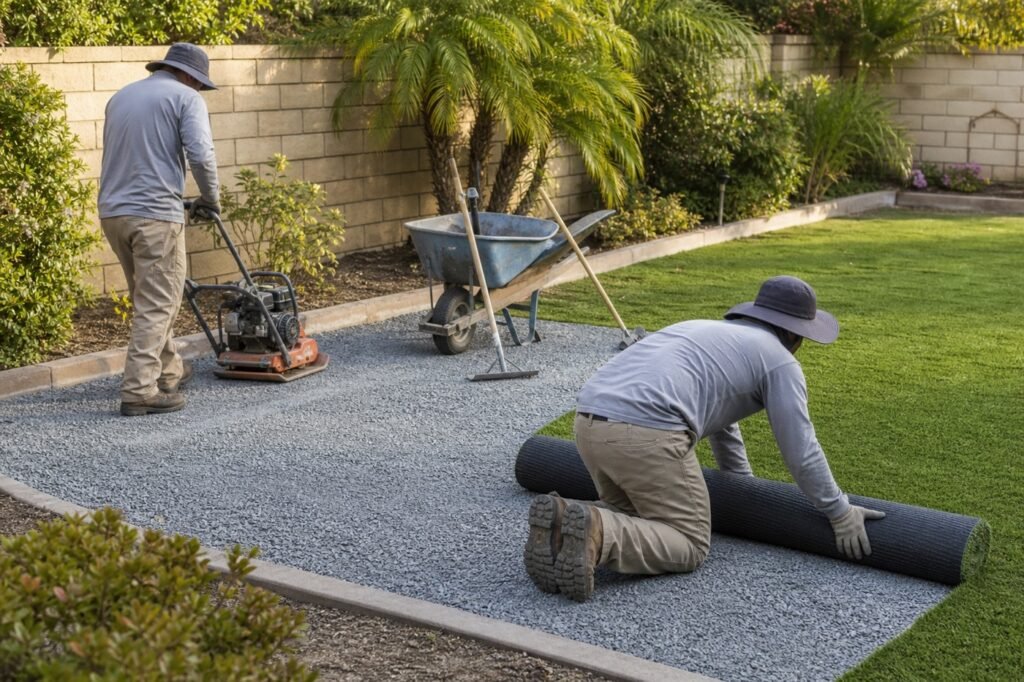
To install artificial turf, you remove the old grass and 3 to 4 inches of soil, lay a weed barrier, spread and compact a crushed rock base, roll out and seam the turf, nail down the edges, and brush in infill. The base is the step that decides whether the lawn stays flat and drains for 15 years or starts to ripple and smell after two summers.
Below are the eight steps professional installers follow when they install artificial turf, what goes under artificial turf, how much base and infill you need, and when DIY makes sense. Option 1 Builders installs artificial turf in Los Angeles and across the San Fernando Valley, and this is the same order of work our crews use.
What Goes Under Artificial Turf?
A long-lasting artificial lawn is a layered system. From the soil up:
| Layer | Typical depth | What it does |
|---|---|---|
| Native soil, graded and compacted | — | Sets the slope so water runs away from the house |
| Weed barrier fabric (permeable) | Thin layer | Slows weeds from below and keeps base rock out of the soil |
| Crushed rock base (class II road base or crushed aggregate) | 3–4 inches compacted | Carries the load and lets water drain through |
| Fine leveling layer (decomposed granite or fine crushed rock) | About ½ inch | Creates a smooth, even surface under the turf |
| Artificial turf with perforated backing | Pile height 1–2 inches | The visible lawn; water drains through the backing |
| Infill (silica sand, coated sand, or pet infill) | Per turf maker's spec | Holds the blades up, adds weight, protects the backing |
Some cities write these layers into their rules. The City of Santa Clarita's front yard landscaping handout, for example, calls for a permeable fabric over native soil, a 3 to 5 inch compacted aggregate base, and a finished surface that drains at least 25 inches per hour.
Tools and Materials You Need to Install Artificial Turf
Whether you install turf yourself or compare contractor bids, this is the equipment list for a typical DIY or professional job.
- Removal and grading: sod cutter, shovels, wheelbarrow, steel rake, and a way to haul off soil.
- Base: weed barrier fabric, crushed rock or class II road base, a fine leveling layer, a garden hose, and a plate compactor.
- Turf: the turf rolls, a utility knife with plenty of fresh blades, a carpet kicker or turf stretcher, seam tape, and outdoor turf adhesive.
- Securing and finishing: galvanized turf nails or landscape staples, a hammer, a drop spreader for infill, and a stiff broom or power broom.
How to Install Artificial Turf in 8 Steps
- Measure and plan. Measure the area, mark sprinkler heads, utility lines, and drains, and decide which way the turf rolls should run. All pieces should face the same direction so the grain matches.
- Remove the old lawn. Cut out the grass and dig out about 3 to 4 inches of soil. Cap or convert the sprinklers in the turf area. Haul off the old sod and dirt.
- Grade the soil. Shape the ground with a slight slope away from the house and toward a drain or the street, then compact it.
- Lay the weed barrier. Roll out a permeable fabric over the soil, overlapping the seams.
- Spread and compact the base. Spread crushed rock in lifts, wet it, and run a plate compactor over each lift until the base is firm and flat. Finish with a fine leveling layer and screed it smooth.
- Roll out and seam the turf. Let the turf relax in the sun, cut it to shape, and join pieces with seam tape and outdoor turf adhesive so the seams disappear.
- Secure the edges. Nail or staple the perimeter every few inches, and tuck or trim the edges cleanly along walls, curbs, and pavers.
- Add infill and brush. Spread infill with a drop spreader, brush it in against the grain, rinse, and brush again so the blades stand up.
A professional crew usually finishes a 1,000 square foot front yard in two to four days. Most of that time goes into demolition and the base, not the turf itself.
The Artificial Turf Base: Where Most Installs Go Wrong
When an artificial lawn fails, the base is almost always the reason. These are the common shortcuts we see when we are called to fix someone else's install:
- Turf laid on dirt. Soil shifts and holds water, so the lawn develops dips and puddles within a year.
- Base not compacted. Loose rock settles under foot traffic and leaves low spots.
- No slope. Water and pet urine sit under the turf instead of draining away.
- Too few nails at the edges. Edges curl up in the heat and become a trip hazard.
- Seams glued in the shade or on a cold morning. The adhesive does not bond and seams open later.
Our guide to why artificial turf installations fail walks through each of these with photos of what to look for.
Artificial Turf Infill: Which Type to Use
| Infill | Good for | Notes |
|---|---|---|
| Silica sand | Standard lawns | Low cost, adds weight; use rounded sand, not sharp sand |
| Coated sand (acrylic coated) | Family yards | Smoother feel, less dust, stays cleaner |
| Zeolite or pet infill | Dog areas | Holds ammonia odor until rinsed; pair with a draining base |
| Cooling infill | Full-sun yards | Holds water and releases it to lower surface temperature |
How much infill? Follow the turf manufacturer's spec. Most residential turf takes roughly 1 to 2 pounds per square foot, spread in thin passes and brushed in between each one.
When Is the Best Time to Install Artificial Turf?
In Los Angeles you can install artificial turf any time of year. Mild, dry days from fall through spring are the easiest for a DIY install, since crews and homeowners are not hauling rock in 100°F heat. Avoid gluing seams in the rain or on a cold, damp morning, because outdoor turf adhesive needs a dry, warm surface to bond.
DIY vs Professional Artificial Turf Installation
| DIY | Professional | |
|---|---|---|
| Cost | Turf and materials only, plus tool rental | About $8–$20 per sq ft installed in Los Angeles |
| Tools needed | Sod cutter, plate compactor, turf cutter, power broom | Brought by the crew |
| Time for 500 sq ft | Several weekends | Usually 1–3 days |
| Hardest part | Hauling soil and compacting the base | — |
| Warranty | Turf product warranty only | Product plus workmanship (ours: 15-year turf warranty) |
Is it hard to install artificial turf yourself? A DIY install works best for a small, flat space like a side yard or balcony. For a full front or back yard, the demolition, haul-off, and compaction are where most homeowners decide a crew is worth it. See our artificial turf installation cost guide for Los Angeles for prices by yard size.
Installing Artificial Turf on Dirt, Concrete, or a Slope
- On dirt: do not lay turf straight on soil. Dig out, add fabric, and build a compacted rock base first.
- On concrete: turf can go over a slab or patio using a foam pad and drainage holes or a drainage mat, glued down instead of nailed.
- On a slope: extra nails, a well-compacted base, and sometimes a retaining edge keep the turf from creeping. Very steep slopes may need terracing first.
- Between pavers: to install turf between pavers or stepping stones, cut each strip slightly wide with a utility knife, then trim it to fit tight against the paver edges and nail it every few inches. Brush infill in last so the edges sit flat.
- For a putting green: the base must be deeper and flatter. See putting green installation.
Questions About Installing Artificial Turf
What are the steps involved in installing artificial grass?
How deep should the base be for artificial turf?
Do you need a weed barrier under artificial turf?
Will weeds grow through artificial grass?
How long does artificial turf last?
How much is 1,000 square feet of artificial turf installed?
Does artificial turf drain well?
Can you install artificial turf over dirt?
Does artificial turf get hot?
Artificial Turf Installed Right by Option 1 Builders
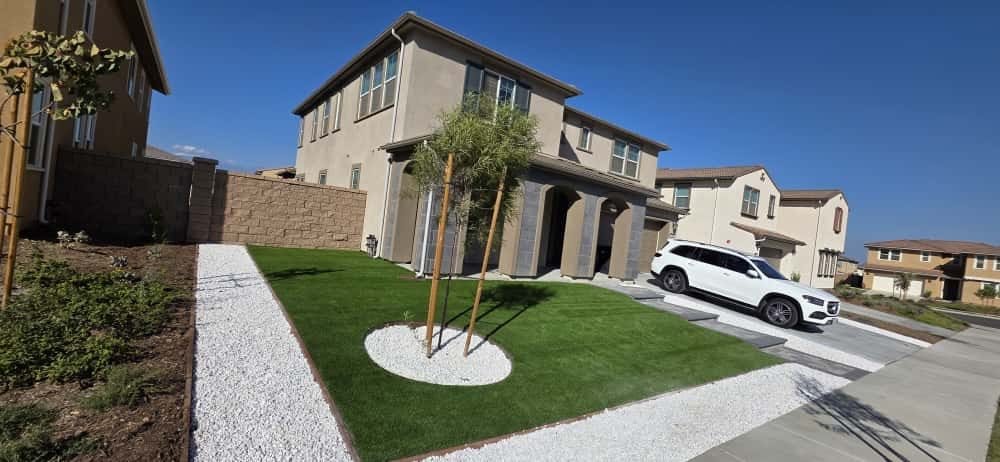
Option 1 Builders is a licensed California general building contractor (CSLB #1122918) at 16400 Ventura Blvd, Suite 319, Encino, CA 91436. We build every lawn on a compacted, draining base, and every artificial turf installation carries a 15-year warranty. See finished yards on our projects page, including this front yard turf project in Santa Clarita, or read about artificial grass installation in Encino.
Want it done for you? Request a free estimate or call 818-297-2475.